
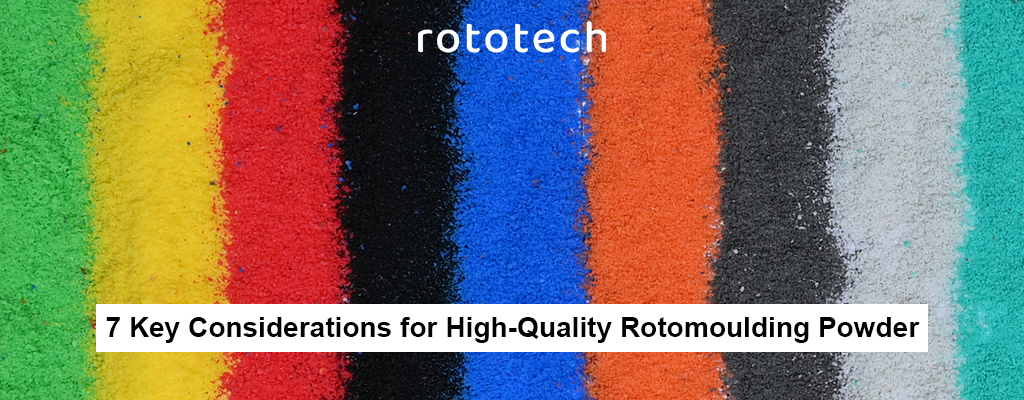
Choosing the right rotomoulding powder is crucial for producing durable, consistent, and high-performance moulded products. Whether you manufacture tanks, containers, planters, or automotive components, the quality of your powder directly affects the strength, finish, and life of the final product. To help you make the right decision, here are seven key considerations every manufacturer should keep in mind while selecting rotomoulding powder.
Table of Contents
Toggle7 Key Considerations
Material Purity and Resin Quality
High-quality rotomoulding powder starts with pure, virgin-grade polyethylene resin. Impurities or recycled mix can weaken the product, reduce impact strength, and cause defects like pinholes or uneven textures. Always ensure the powder is made from certified LLDPE / HDPE with no contamination.
Better resin quality = stronger, more reliable finished products.
Consistent Particle Size Distribution
Uniform particle size ensures smooth flow, melt consistency, and even wall thickness during moulding. Powders that are too coarse or too fine may lead to issues such as:
- Incomplete melting
- Surface defects
- Poor impact resistance
Choose a powder with optimal micron size (usually 35 mesh to 100 mesh) for seamless processing.
Excellent Flow and Sintering Properties
Good rotomoulding powder should melt evenly and bond smoothly during sintering. Proper flow behavior helps achieve:
- Strong fusion between layers
- Smooth surfaces
- No bubbles or voids
Check the powder’s MFI (Melt Flow Index) and sintering characteristics to ensure consistent performance.
UV Stability and Weather Resistance
Outdoor products like water tanks, planters, and road safety items require UV-protected material to withstand long-term sunlight exposure. A high-quality powder includes UV stabilizers (UV8, UV10, UV15 etc.) that prevent cracking, colour fading, and structural degradation.
For outdoor applications – UV stability is non-negotiable.
Colour Accuracy and Heat Stability
- Uniform colour dispersion
- Fade resistance
- Batch-to-batch consistency
High Impact Strength and Durability
The end product must be able to withstand stress, drops, and pressure. Choose a powder with:
- High impact strength
- Crack resistance
- Flexibility with toughness
This is especially important for water tanks, industrial containers, dustbins, chemical tanks, and heavy-duty moulded parts.
Reliable Supplier and Quality Certification
Even the best resin means nothing without a trusted manufacturer. Choose suppliers who offer:
- Regular quality tests
- ISO certifications
- Material test reports (MTR)
- On-time supply and consistent batches
A reliable supplier ensures long-term performance and eliminates production issues.
Conclusion
Selecting the right rotomoulding powder is a crucial step that directly influences the quality, durability, and finish of your moulded products. By focusing on purity, particle size, flow characteristics, UV stability, and supplier reliability, you can ensure consistent production and premium-quality results every time.